Peptide biotechnology · Mannheim and Heidelberg
Bioportide kits and peptide manufacturing
The Bioportide kits of Better Peptides Platform (BPP) deliver DNA and RNA into organisms that resist standard transformation methods, among them cyanobacteria and ascomycetes, and into E. coli without the need for competent cells. The kits are available in packs of 10 to 100 reactions. BPP also manufactures linear and cyclic peptides of 15 to 250 amino acids by microbial fermentation, in a process that requires no dimethylformamide, acetonitrile or dichloromethane.
Two routes
What do you need?
Your organism is difficult to transform. Standard transformation protocols do not work, competent cells take days to prepare, or you have no electroporator.
Bioportide transformation kits
A cell-penetrating peptide facilitates delivery of DNA and RNA into the cell, with no competent cells, no heat shock and no instrument. Dedicated kits are available for Escherichia coli, cyanobacteria and ascomycetes, along with four BPP Bioportide™ Exploration Kits sorted by envelope type.
- Cargo
- DNA or RNA, 22 nt to more than 10 kb
- Pack sizes
- 10 to 100 reactions
- Published result
- 473 colonies from 10 ng of DNA
- Price from
- €128 for 10 reactions
- Use
- Research use only
You need a peptide manufactured, and want to know whether it can be produced at your length, purity and scale.
Recombinant peptide manufacturing
BPP produces the peptide as part of a carrier fusion that protects it from proteolysis inside the host cell. The target peptide is then released and purified. The technology also enables recombinant production of cyclic peptides without a separate chemical cyclisation step. Send us your sequence and required quantity to find out whether the peptide can be manufactured using our technology.
- Peptide length
- 15 to 250 amino acids
- Structure
- linear and cyclic
- Solvents
- No DMF, no acetonitrile and no dichloromethane required
Technology
How are a Bioportide and a made-to-order peptide built?
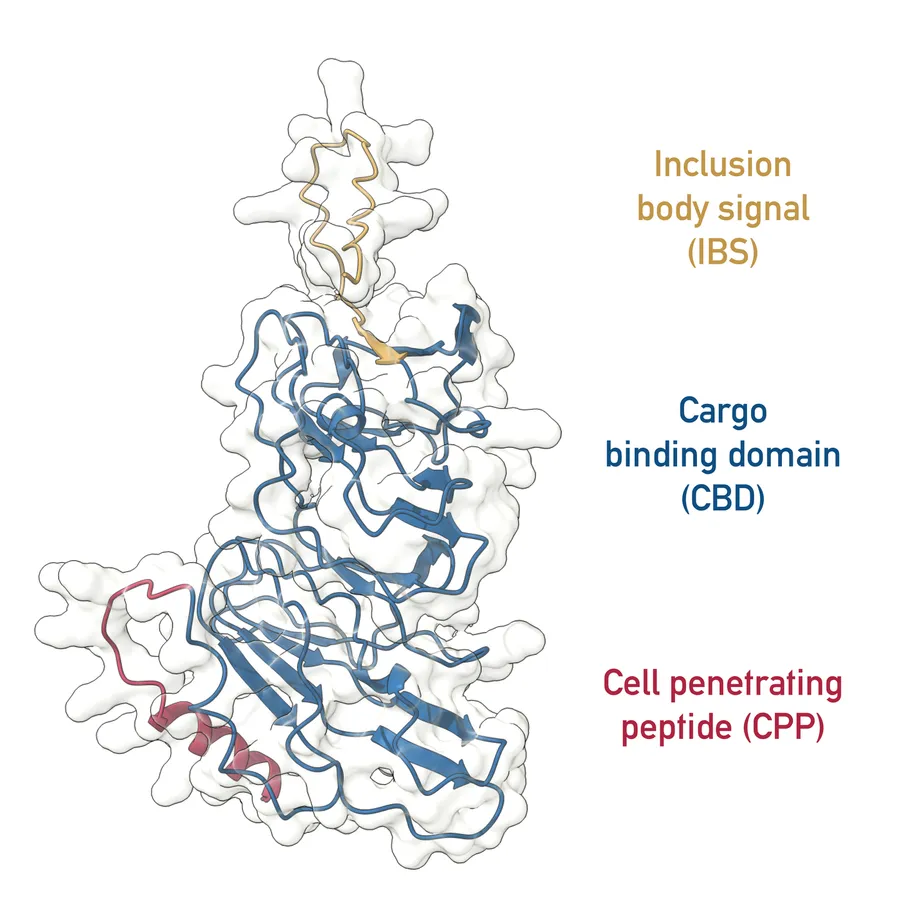
Both technologies use recombinant fusion proteins that BPP designs using different functional domains and produces in E. coli. Each domain has a specific function.
Bioportide
A BPP Bioportide™ consists of three domains: a cargo-binding domain that binds the nucleic acid, a cell-penetrating domain that carries it across the cell envelope, and an inclusion body signal used in production.
Peptide manufacturing
A custom peptide is produced as part of a carrier fusion protein. The carrier domain aggregates the fusion protein in inclusion bodies and binds to the purification matrix, while a pH-sensitive release domain cleaves off the target peptide with authentic termini. The carrier also protects the peptide from degradation by cellular proteases, which can be a challenge when directly expressing peptides shorter than 50 amino acids.
Evidence
Measured, peer reviewed, awarded
The BPP Bioportide™ transformation results were obtained at the University of Tübingen and published in a peer-reviewed study. BPP’s peptide technology platform received the Bioeconomy Innovation Prize Baden-Württemberg in 2023.
It has revolutionized our ability to transform previously challenging target organisms like Anabaena or Nostoc. The benefits in terms of time savings, reduced DNA usage and improved efficiency are remarkable, opening up new research possibilities.
Microbiology / Organismic Interactions, University of Tübingen
The company
Who develops and manufactures our products
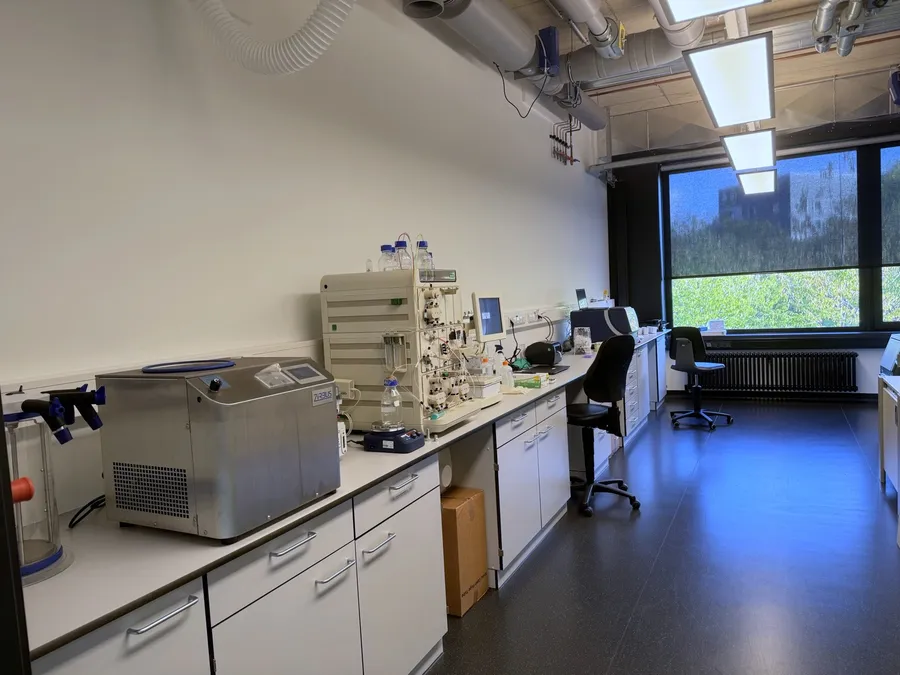
BPP operates laboratories at the Business Development Center Heidelberg. The registered office is in Mannheim. Research and development, peptide production and analytics are carried out in Heidelberg. Our team consists of bioscientists with the expertise to answer technical questions directly.
Founded 2020